In an effort to address the rampant inequities that the black population faced in 1960s American society, the leaders of the Civil Rights movement believed that they had come up with the perfect solution. The integration of the blacks into the larger society would surely provide them with  access to everything they needed to live on a level playing field: health care, quality education, better housing, as well as access to employment previously denied to the black population. However, in light of current statistics on a black person’s access to these all-important institutions, author Loray Muhammad comes to the resounding conclusion that has proven to be of limited success to some, while many members of the population have been completely left behind.
In short, black integration has largely failed in addressing the needs of the majority of blacks in America. Muhammad details precisely why and how in her thought-provoking , concise new book, Black Integration a Failed Social Experiment. By providing and examining national statistics on the current state of blacks throughout America, the author presents an analysis of why black integration failed, relying on facts rather than the heightened emotion that frequently surrounds this topic. Assessing one by one the inadequacies of housing, health care, education, and employment, Muhammad lays out a sound, reason- based case for why the grand social experiment of the previous generation failed to deliver the desired results, and why it’s time to resume the conversation to come up with alternative means of correcting the inequities that continue to stymie the genuine advancement of the black population in the larger society.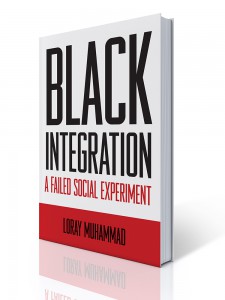
To do so, the author systematically evaluates the institutions that continue to be elusive for much of the black population. She starts before birth, exploring a heal
thcare system that has prenatal care remains out of reach for many in the black community, and remains the domain of those who can afford the type of health care that is provided by employment. From there, she addresses the educational system, providing empirical data demonstrating how the outcomes for blacks, educationally speaking, is consistently lower than the general population. Employment is then considered, and the consistently high rates of unemployment and underemployment in this segment of society. From there, the book expands on the effects of black male unemployment, such as its connection with single parent households and its impact on incarceration rates. The author then assesses the issue of child welfare, the hostility of the banking community to the black community, the prevalence of substance abuse, homelessness, and poverty . The book also covers blacks and the military, blacks as crime victims, mental health, physical health, and senior citizens.
By laying down recent statistics on a social reform policy that many incorrectly assume succeeded, Black Integration a Failed Social Experiment endeavors to reopen the discussion, provoke debate, and consider new modes of reform to advance the masses of blacks in America. Clear-eyed, concise, and rich in quantifiable information, this unprecedented book is certain to broaden the perspective of college students and anyone interested in thinking through new solutions in a changing America.
Single Book $20.00 +shipping and Buy now